Underwater Sear Drainage System About
Features:
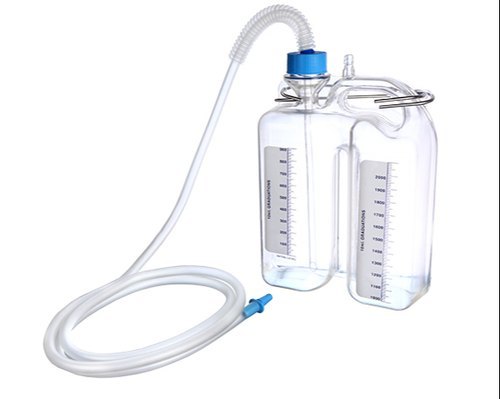
- Double chamber compact unit has 2 litre capacities making it suitable for all cardiac and thoracic procedures.
- Easy to read graduation help to determine the drainage volume precisely.
- Clearly marked initial level ensures the underwater seal.
- Separate suction port is provided for connection with suction unit.
- Kink resistant large bore tubing facilitates unrestricted flow.
- Unit is provided with metal hangers and floor stand.
- Sterile, packed in peelable pouch pack.
- Size Available: 500 ml, 1200 ml, 2000 ml
- Material Used: Medical Grade PVC
Designed for Precision and SafetyThe Underwater Seal Drainage System offers a closed, sterile environment for thoracic drainage. With its transparent chamber and clear graduated measurement scale, clinicians can easily observe drainage and ensure patient safety. The integrated overflow protection and antireflux valve help prevent contamination and backflow, making the system both efficient and hygienic for hospital or clinical use.
User-Friendly and VersatileThis drainage system features a universal connector, ensuring compatibility with a wide variety of surgical and medical setups. Its portable and lightweight design, along with individually packed and sterile units, makes it ideal for emergency, surgical, and inpatient settings. The smooth, glossy finish promotes easy handling and cleaning, while the latex-free material is safe for sensitive patients.
FAQ's of Underwater Sear Drainage System:
Q: How is the Underwater Seal Drainage System set up for use?
A: To set up the system, attach the universal connector to the patient's chest tube, fill the chamber to the prescribed level with sterile fluid, and ensure the antireflux valve is functioning to prevent backflow. Place the system below the patient's chest level for optimal gravity drainage.
Q: What is the primary application of this drainage system?
A: The product is used for pleural and thoracic drainage, efficiently removing air, fluid, or pus from the intrathoracic space after chest surgery, trauma, or infection, helping restore normal respiratory function.
Q: When should the drainage system be replaced or disposed of?
A: Because this device is designed as a single-use, disposable system, it should be replaced after one use or if the chamber reaches its 1000 ml capacity, or earlier if contamination is suspected.
Q: Where can this system be used in clinical practice?
A: The system is suitable for use in hospitals, ambulances, emergency departments, operating rooms, and ICUs where closed chest drainage is required.
Q: What are the advantages of the integrated antireflux valve and overflow chamber?
A: The antireflux valve prevents backflow of drained material into the patient's chest, reducing infection risk, while the integrated overflow chamber averts spillage, ensuring safe and hygienic operation.
Q: How does the graduated measurement scale assist healthcare professionals?
A: The transparent, graduated scale allows easy monitoring of the volume and nature of drainage, helping in assessment of patient progress and timely decision-making.

 Send Inquiry



 Send Inquiry


 Send Inquiry


